
Fuel Cost Sharing Analysis
RMI's new tool helps estimate customer savings under a range of potential fuel cost sharing policy options.
Overview
In most states, fuel costs are passed through 100% to customers, resulting in poor incentives for utilities to manage those costs properly. Some states have addressed this problem by instituting fuel cost sharing. To help states navigate if fuel cost sharing is right for them, RMI has built the Fuel Adjustment Cost Sharing Savings (FACSS) model to help inform if and how states can design a fuel cost sharing policy. With this tool, users can analyze the potential savings from a fuel cost sharing policy and model different policy design options.
The model estimates the customer savings under a hypothetical fuel cost sharing policy over the past five years. It compares expected fuel costs to actual fuel costs at power plants; applies the selected sharing rate to the difference; and aggregates results at the state level (see Methodology tab for more detail).
Note: The fuel cost sharing analysis only includes results for vertically integrated states that do not currently have fuel cost sharing in place. Regulated utilities in restructured states are not responsible for fuel procurement.
RMI has done preliminary analysis for several states. Between 2020–2024, net cumulative savings for utility customers in the following states would have been:
- Georgia: $43.7 million
- Nevada: $36.7 million
- New Mexico: $12.4 million
- North Carolina: $89 million
- Utah: $21.6 million
- Virginia: $20 million
For additional information on each state's fuel cost savings, you can download a PDF fact sheet by clicking the totals above.
Fuel Cost Sharing 101
Fuel cost sharing is a policy that provides a financial incentive for a utility to carefully manage its fuel costs (e.g. how much natural gas is purchased for power generation) by exposing the utility to a portion of fuel-cost volatility risk, allowing a utility to earn more if it reduces fuel costs or absorb a share of the burden if fuel costs rise.
In most vertically integrated states, utilities pass through 100 percent of their actual spending on fuel to customers through policies called “fuel adjustment clauses” (FACs). FACs are rate riders that automatically true up the revenues collected from customers to match the utility’s actual fuel expenditures. By insulating the utility from the risks of poor fuel-cost management decisions — or rewarding the utility for making good decisions — FACs give it little incentive to reduce fuel costs. FACs create a situation that economists call “moral hazard,” which exists when one party makes the decisions while another bears the risk of those decisions.
Fuel cost sharing exposes the utility to a portion of the fuel cost volatility risk, so it is no longer fully insulated from fuel cost changes as it is under a traditional FAC. Instead, under fuel-cost sharing the utility has some “skin in the game.”
Under fuel cost sharing, an estimate of expected fuel costs is first built into rates, and then only part of the difference between the revenues collected and the utility’s actual fuel expenditures is trued up. As is the case for a traditional FAC, this true-up is performed through a rider that applies an additional charge or credit to customer bills. The key difference is that fuel cost sharing trues up only part of the difference between the utility’s expected and actual fuel costs, depending on the percentage sharing rate.
The simplest structure for a fuel cost sharing mechanism is to require the same level of utility fuel cost responsibility (e.g., 10 percent) regardless of how much the utility's actual costs deviate from expectations. This approach, which is sometimes called "straight sharing," is the most common among existing fuel cost sharing policies.
Example
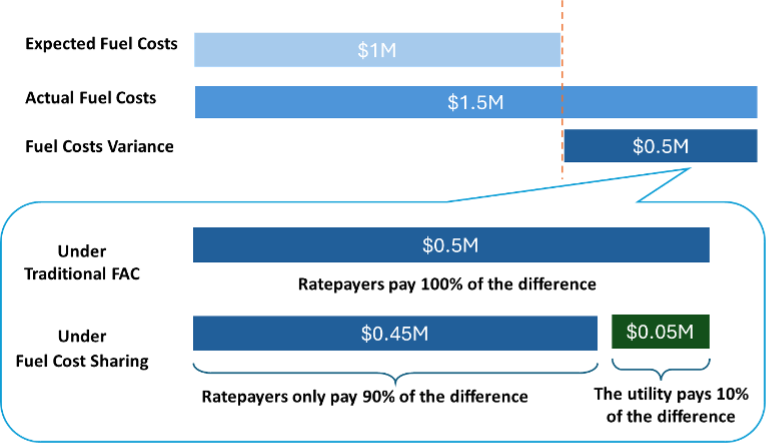
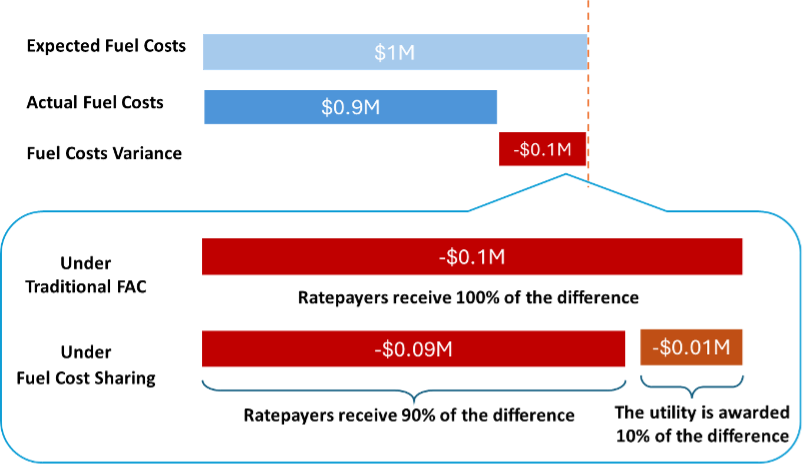
In the two following examples, a utility expects total fuel costs for the coming year to be $1 million, and there is a 90%/10% sharing rate.
If actual costs are greater than expected prices
At the end of the year, actual fuel costs were $1.5 million. Under a traditional FAC, customers would pay the full $1.5 million. Under a fuel cost sharing policy with a 90%/10% sharing rate, ratepayers would only pay 90% of the difference between the $1 million and $1.5 million.
Fuel Cost Savings = (expected fuel costs – actual fuel costs) × sharing rate
($1,000,000 – $1,500,000) × 90% = $450k of the difference
Ratepayers pay $1,450,000 overall.
The utility pays ($1,000,000 – $1,500,000) × 10% = $50k.
- Ratepayers cover $500k × 90% = $450k of the difference (but pay $1.45M overall)
- Utility covers $500k × 10% = $50k
Ratepayers save $500k - $450k = $50k compared to what they would have paid without sharing. Utility investors are on the hook for the $50k, creating a financial incentive to reduce that amount as much as possible.
If actual costs are less than expected prices
At the end of the year, actual fuel costs were $900,000. Under a traditional FAC, customers would pay the full $900,000, and the utility would see no financial benefit from lower fuel costs. Under a fuel cost sharing policy with a 90%/10% sharing rate, ratepayers would only "pay" 90% of the difference between the $1 million and $900,000.
- Ratepayers receive $100k × 90% = $90k in savings, rather than the full $100k.
- Utility investors would be awarded $100k × 10% = $10k in additional profits.
Ratepayers would pay less overall compared to a traditional FAC, but would not receive the full savings amount. The utility keeps part of the savings, creating a financial incentive.
Note: The model does not take into account potential changes in utility investments and operations that may result from a fuel cost-sharing policy (e.g., greater investment in fuel-free resources like solar or energy efficiency), which could have created even greater benefits for both customers and investors. This means that estimated cost savings are likely an underestimate of potential savings that could result from fuel cost sharing. The intent of this policy is to create “win-win” scenarios where both the utility and customers benefit. In a real-life scenario where this policy is implemented, a rationally acting utility should respond to the fuel cost-sharing policy by pursuing strategies to reduce fuel expenditures, resulting in a situation where the utility lowers costs for customers and is able to keep some of the resulting savings.
Additional Sharing Mechanism Components
The examples above illustrate the simplest version of a fuel cost sharing mechanism. Additional design components include deadbands, thresholds, and caps. The figure below illustrates a mechanism with a deadband and thresholds. Under a deadband, a regulator could adopt a mechanism that performs no pass-through if actual fuel costs fall within 25 percent of the expected value, for example. Sharing would occur if actual costs are between 25 to 75 percent greater than or less than that value, and a 100 percent pass-through would occur if they deviate by more than 75 percent.

Regulators can also set a cap on the total dollar amount that is shared between customers and the utility.
Key Authors
Xavier Zheng, Jeffrey Sward, Oliver Tully, and Joe Daniel
This work is licensed under Creative Commons Attribution 4.0 International Public License (CC BY 4.0). A copy of the license may be found here. By accessing and using this work, you agree to be bound by the terms of this license. RMI does not warrant or represent that the information is appropriate or sufficient for your purposes, and your use of this work is at your own risk. RMI shall not be liable for any claims, losses, costs, liabilities, or damages that may arise from or in connection with use of this work.